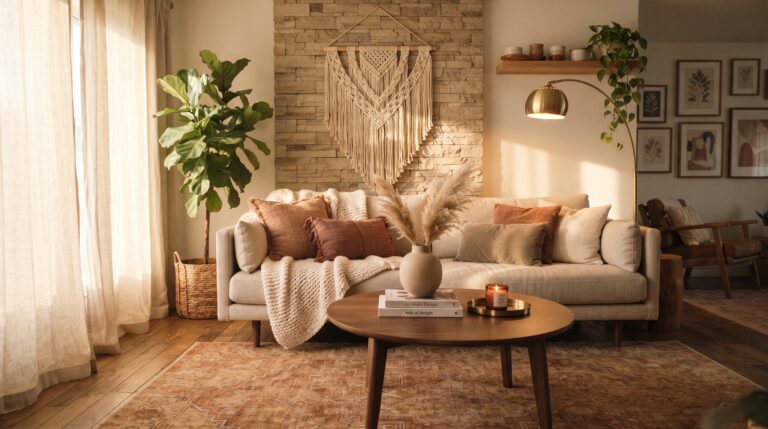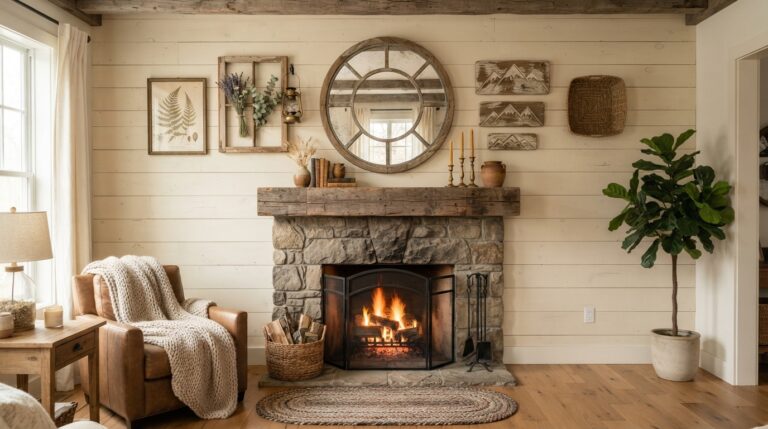
20 Bohemian Style Living Rooms That Feel Warm and Collected
Boho living rooms get talked about like they’re all thrifted rugs and a few plants tossed in a corner. The good ones are smarter than that.
There’s usually a quiet plan underneath. Warm wood, layered textiles, one or two colors doing the heavy lifting, and enough breathing room that nothing feels crowded. That’s why some spaces feel like a slow Saturday afternoon while others just feel cluttered. The difference is almost never money. It’s how the layers stack.
These 20 boho living room ideas break the look down piece by piece. Some lean neutral and calm, others go bold with Moroccan patterns and deep velvet. A few are made for rentals where drilling into walls isn’t an option. Others suit big open rooms that need softening before they feel livable.
Every idea comes with real materials (jute, rattan, oak, linen, leather) and the reasoning behind why the combo works, not just a pretty picture to scroll past. Grab a coffee, start saving the ones that feel like home, and pay attention to the small moves. Those are usually the ones that change everything.
1. Leather Sofa
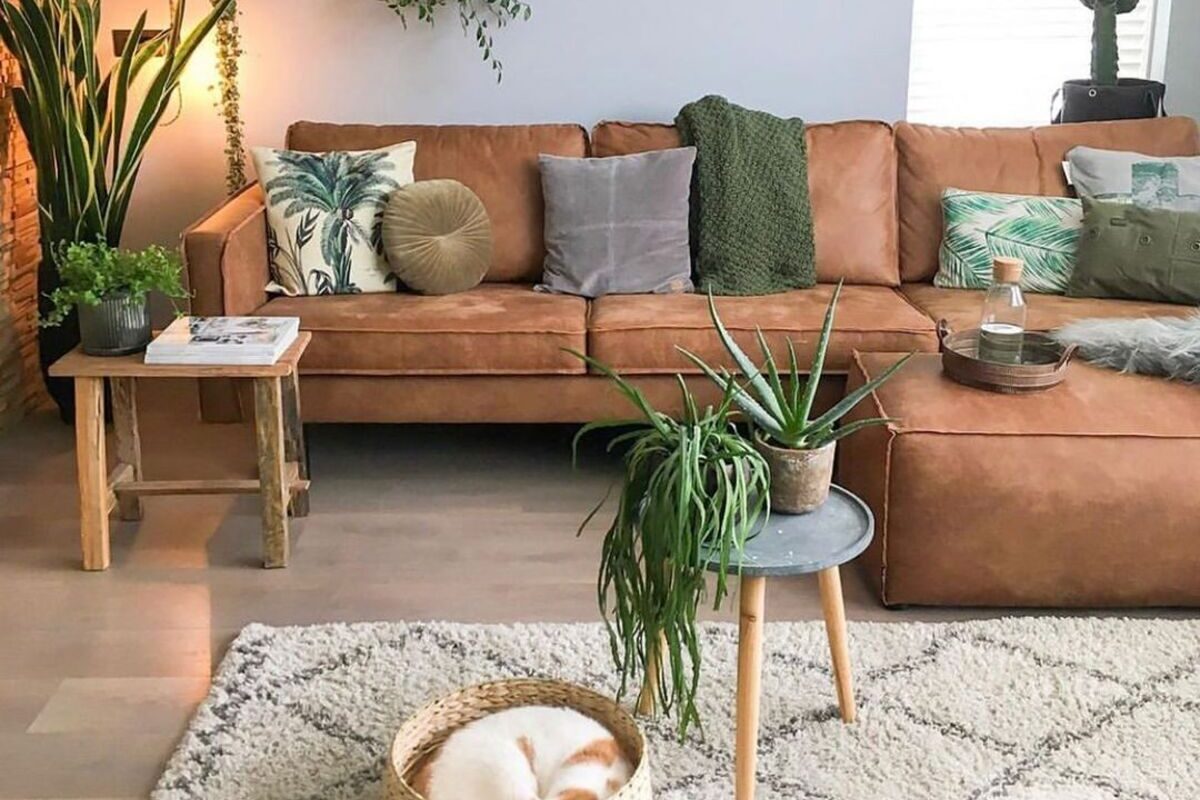
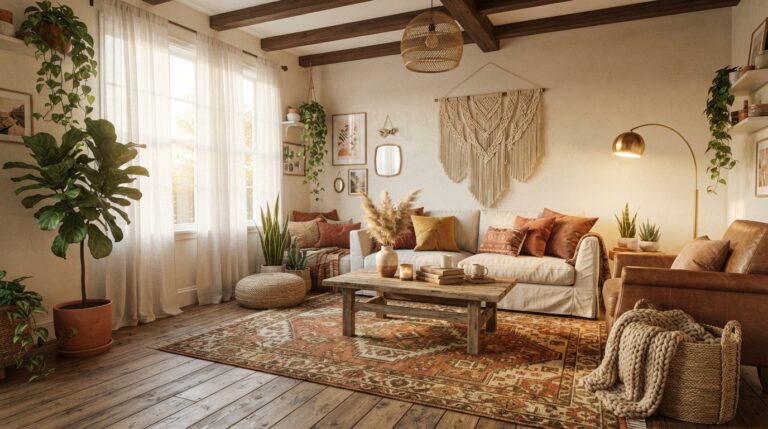
A worn cognac leather sofa might be the most underrated piece in any boho living room. It looks like it’s been in the family for years, and that lived-in softness is exactly what keeps all those woven textures from feeling like a craft fair booth.
Leather works here because it acts as an anchor. Boho leans soft and busy by nature, with fringe, macramé, and layered pillows everywhere. A solid leather frame gives the eye somewhere calm to land. Pile on a sheepskin throw and a couple of mudcloth pillows, and the contrast between smooth hide and nubby cotton does most of the styling for you. Bonus: leather takes spilled coffee and dog naps without holding a grudge.
Best suited for busy households that want boho charm with furniture that ages instead of wearing out.
2. Boho Artwork

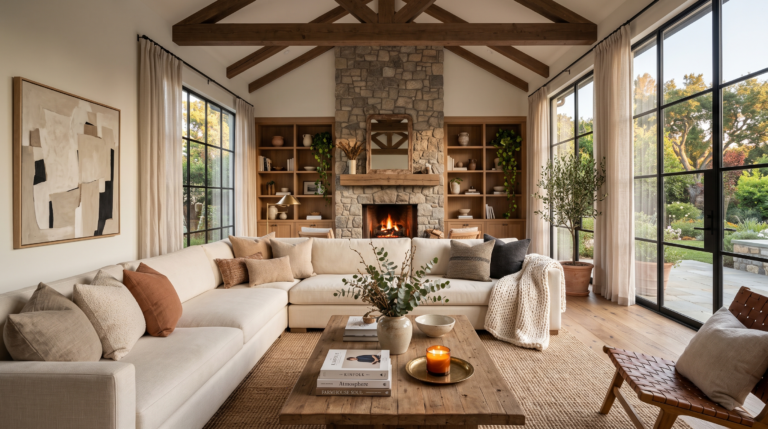
Boho art doesn’t try to match anything, and that’s the whole trick. Think faded desert landscapes, loose abstract line drawings, hand-painted florals on unframed canvas, or a woven tapestry hung from a plain wooden dowel.
Why it works: boho rooms are already full of texture down low, in the rugs, the poufs, the stacked pillows. Blank walls above all that make the room feel unfinished, like someone moved in and stopped halfway. Art fills that gap without adding clutter to the floor. Mix frame finishes on purpose too. A raw oak frame beside a thin black one beside no frame at all reads as collected over time rather than bought in one afternoon.
Hang one piece slightly lower than feels correct. That small drop pulls the wall and the sofa into the same conversation.
3. Farmhouse Boho Living Room
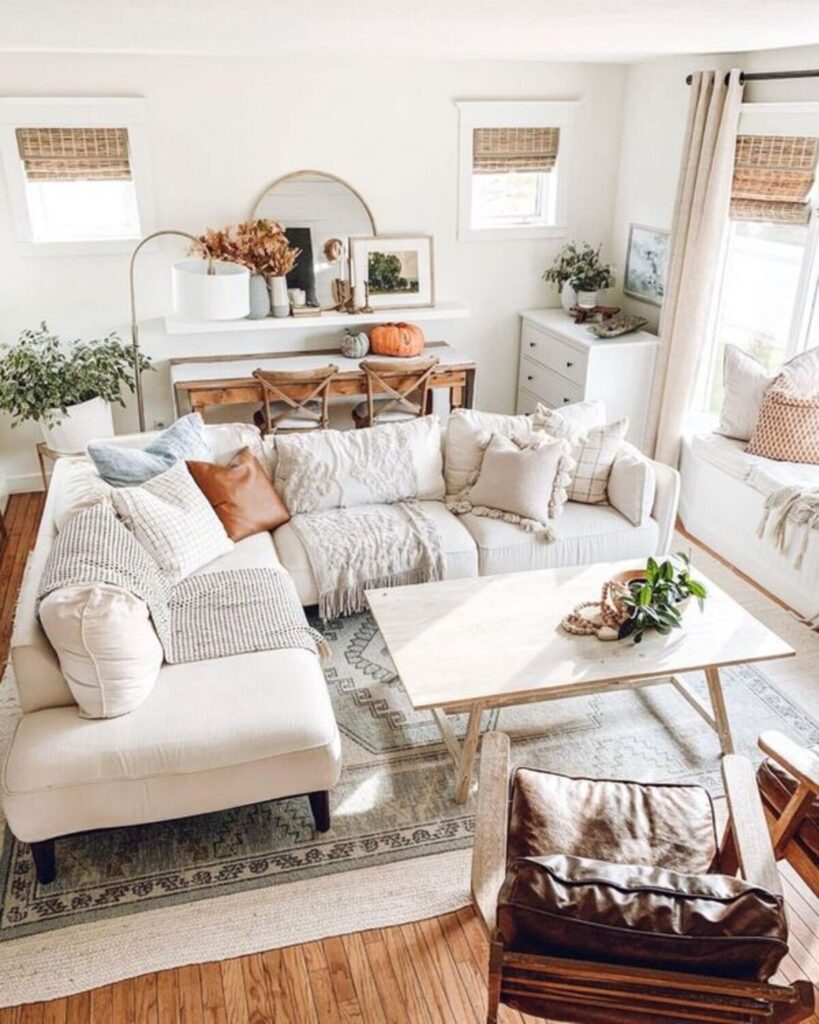
Farmhouse and boho sound like they’d fight each other. One is tidy and painted white, the other is layered and a little wild. Put them together and the room somehow calms down.
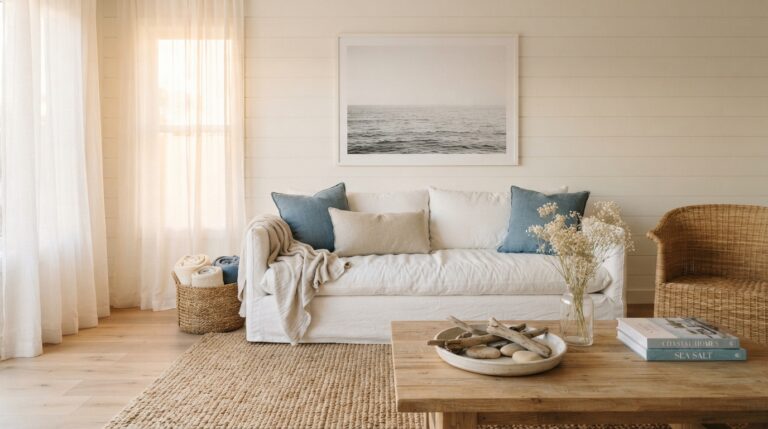
The overlap is natural material. Shiplap walls, a reclaimed wood coffee table, and a linen slipcovered sofa all live comfortably next to jute, rattan, and macramé because everything shares the same honest, unfussy surface. Farmhouse brings the structure, clean lines and a mostly neutral base. Boho softens it with fringe, mismatched pillows, and a trailing pothos on the mantel. Without that softening, farmhouse can read a bit staged and cold.
Keep the palette to warm white, oatmeal, and weathered wood, then let one black iron detail sharpen it up.
Perfect for older homes with good bones that need warmth more than renovation.
4. Mix Of Textiles
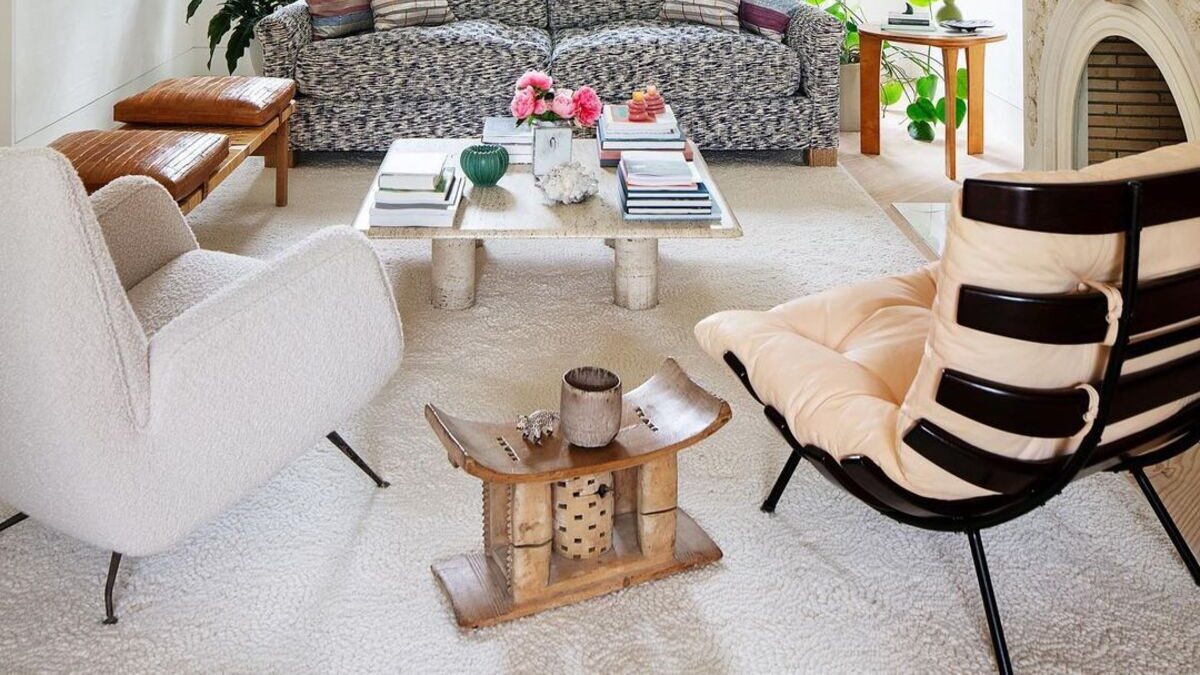
This is the part people skip, and it’s the reason a boho room can look flat even when every single piece is technically correct.
Texture is what boho uses instead of loud color. A nubby wool throw over a smooth cotton sofa, a chunky knit pouf beside a flatweave kilim, sheer linen curtains against a rough jute rug. Your eye reads all those different surfaces as depth, so the room feels full without needing more stuff in it. Aim for three or four textures minimum in one sightline. Two isn’t enough to register.
The rhythm matters as much as the count. Rough, smooth, rough, smooth. Skip that and everything blurs into one soft heap.
💡 Pro tip: Squint at the room from the doorway. If the surfaces blend into a single fuzzy mass, you need one hard texture in there, a leather pillow, a brass tray, something with a bit of shine to break the run.
5. Moroccan Accents
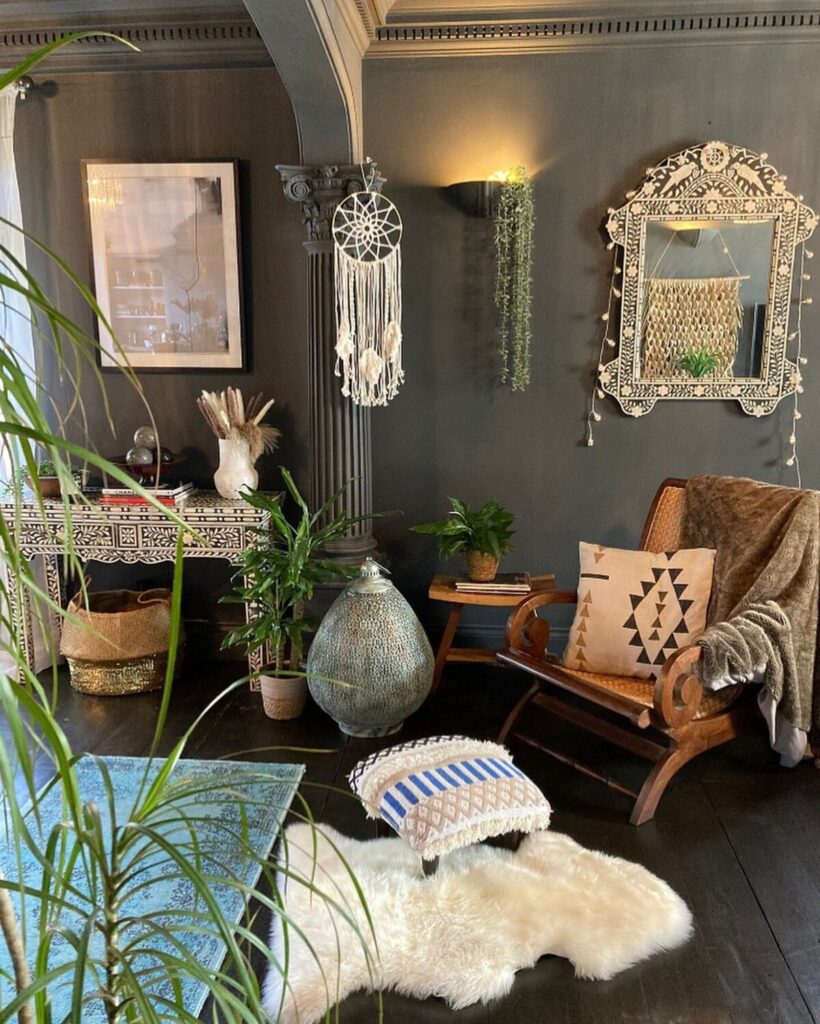
Moroccan pieces carry boho rooms further than almost anything else, mostly because they were built for layering long before it was a trend. A Beni Ourain rug with its cream wool and thin charcoal diamonds. A pierced brass lantern throwing patterned shadows across the ceiling. A low pouf in dyed leather that goes soft and creased with use.
The reason it works comes down to scale and repetition. Moroccan design leans on small repeating motifs, tiny diamonds, stars, tight geometry, and repetition reads as calm even when the pattern is busy. So you get visual interest without the chaos you’d get from one big loud print.
One rule keeps it from going themed: pick two or three pieces, not ten. A rug, a lantern, maybe a pouf. Past that it stops feeling collected and starts feeling like a showroom.
Evenings are when this one earns its keep. Light the lantern and the whole ceiling turns into pattern.
🌟 Suggestion: Set the lantern low, on the floor or a short stool rather than a side table. The shadows stretch upward instead of pooling on the tabletop, and the room feels twice as tall after dark.
6. Wooden Furniture
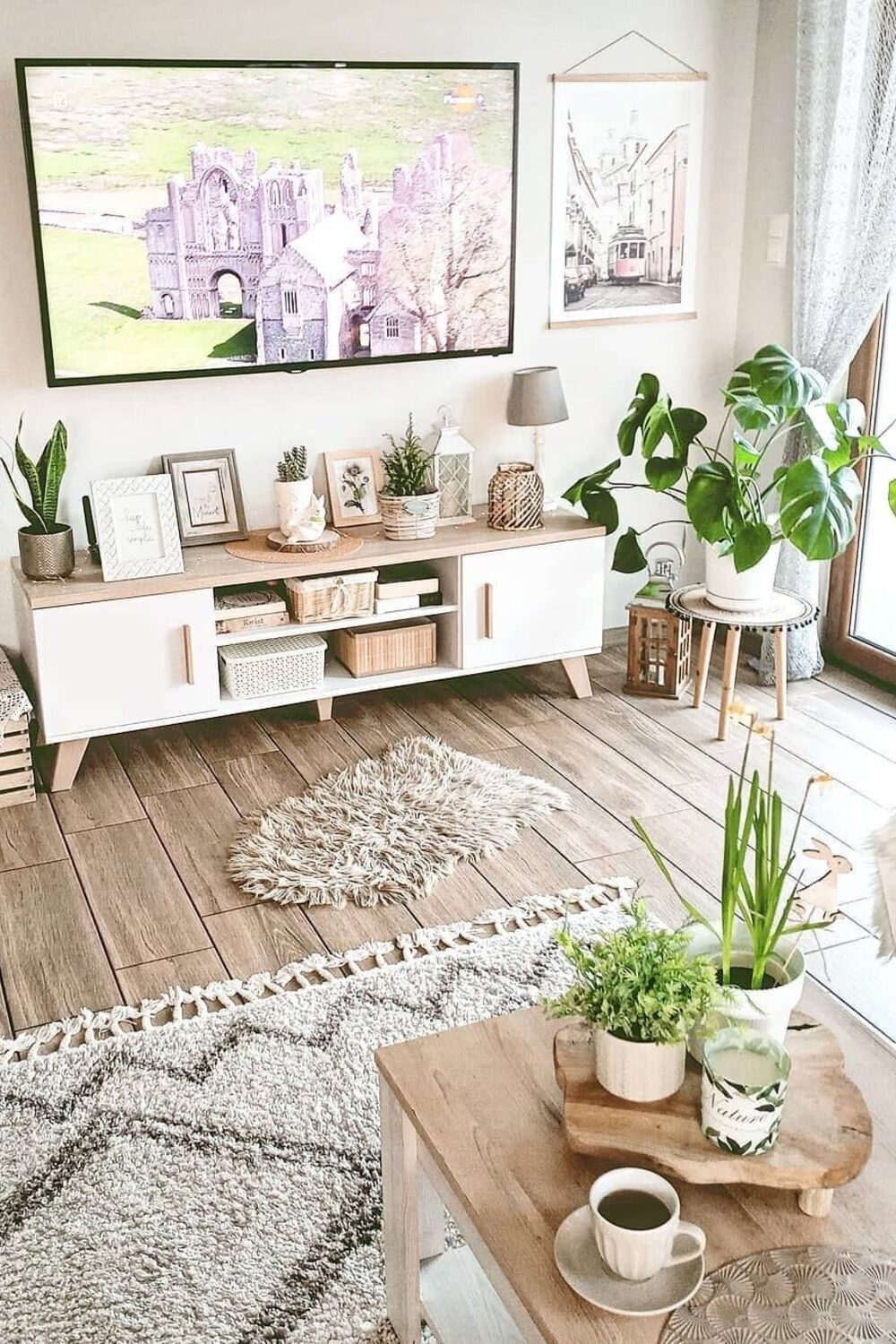
Wood is the quiet backbone of every boho room that actually works. Not matching wood, though. That’s where people go wrong, hunting for a coffee table that matches the shelf that matches the side table.
Mixed tones are what you want. Pale oak next to dark walnut next to sun-bleached teak. The variation reads as things gathered over years, which is the entire feeling boho is chasing. Look for visible grain and slightly imperfect edges, since sanded-flat perfection kills the effect fast. A live-edge slab, a spindle chair with worn arms, a cane cabinet with warm patina.
There’s a practical side too. Wood grounds all the soft stuff. Without a few solid pieces holding their shape, a room full of pillows and throws starts to sag visually.
The trick is contrast in tone, not harmony. Sameness is what makes wood look like furniture. Difference is what makes it look collected.
7. Boho In Grey Tones
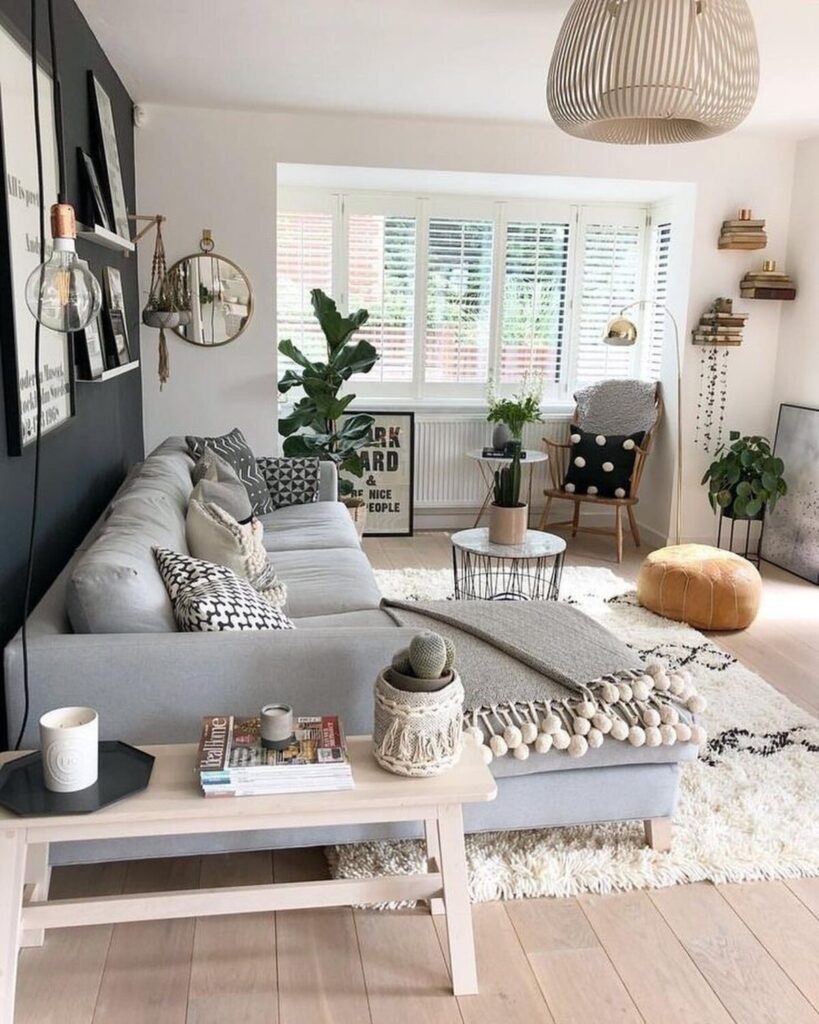
Grey boho sounds like a contradiction, and honestly it can go wrong. Get the undertone off and the room turns into a rainy Tuesday.
Warm greys are the answer. Greige, dove, mushroom, anything with a whisper of brown or taupe in it. Cool blue-greys fight the jute and rattan and make everything look slightly sad. Warm grey does the opposite, letting natural fibers glow against it. Layer a soft grey linen sofa with cream macramé, a charcoal flatweave rug, and pale wood, then add one warm thing, terracotta or rust, to stop the whole scheme from flattening out.
What you get is boho with the volume turned down. All the texture, none of the visual noise.
It’s the version that still feels restful at the end of a long day, when a bright patterned room would just feel like more noise to process.
8. Neutral Boho Living Room

Strip the color out entirely and something interesting happens. You start noticing shape.
That’s the logic behind a neutral boho living room. Cream, sand, oatmeal, bone, tan, all sitting within a few shades of each other. With no color competing for attention, the eye picks up on silhouette and surface instead: the curve of a rattan chair, the fringe on a wool rug, the slouch of a linen slipcover. Texture has to carry the room, so it needs to be generous. Thin neutrals look like an unfinished rental.
Vary the depth too. Pure white beside oatmeal beside a deeper camel keeps the tonal range alive rather than washed out.
Morning light is the payoff here. Sun hits all those pale layers and the whole room goes gold for about an hour.
9. Mix And Match Vintage And Modern Pieces

Rooms that look effortless almost never came from one store. There’s usually an old thing sitting next to a new thing, and the gap between them is doing the work.
Here’s why. A clean-lined modern sofa beside a chipped vintage trunk creates tension, and tension is what makes a room interesting to look at. All vintage feels like a antique booth. All modern feels like a waiting area. Together they read as a real person with a real history, which is exactly the boho promise. Keep the ratio loose, maybe 70 percent current pieces and 30 percent found ones, so the old stuff feels chosen instead of inherited by accident.
💡 Pro tip: Let one vintage piece show its damage. A scratched tabletop or a faded rug edge gives the eye proof that the room wasn’t styled yesterday, and everything around it relaxes because of that.
10. Jute Rugs
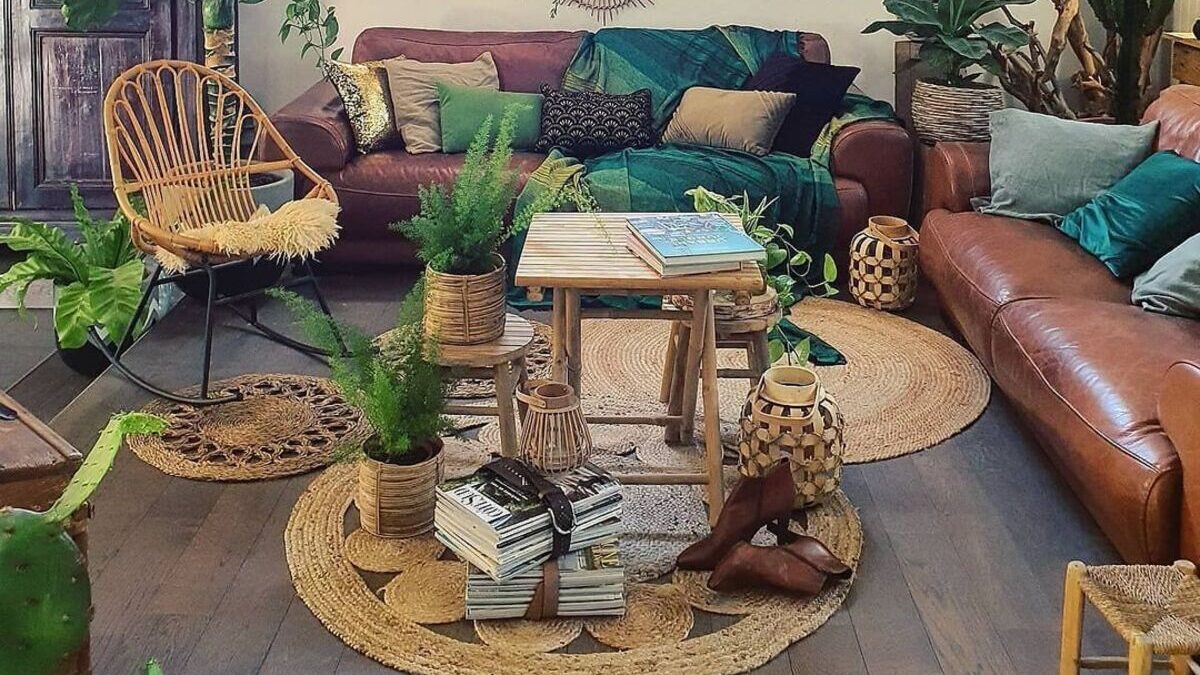
If there’s one piece that does the most for the least money, it’s a big jute rug. That coarse, sandy weave instantly warms up a cold floor and gives every soft thing above it something rough to push against.
Size is where most people undershoot. Go large enough that the front legs of all your seating sit on it, otherwise the rug floats and the room reads as disconnected. Jute also handles layering better than almost any other base, so throw a smaller kilim or a vintage Persian on top at an angle and you’ve got instant depth. The natural fiber underneath keeps the pretty one from looking too precious.
Worth knowing: jute sheds for the first few weeks and it hates moisture, so keep it out of damp basements and away from the front door in rainy months.
11. Include Fur
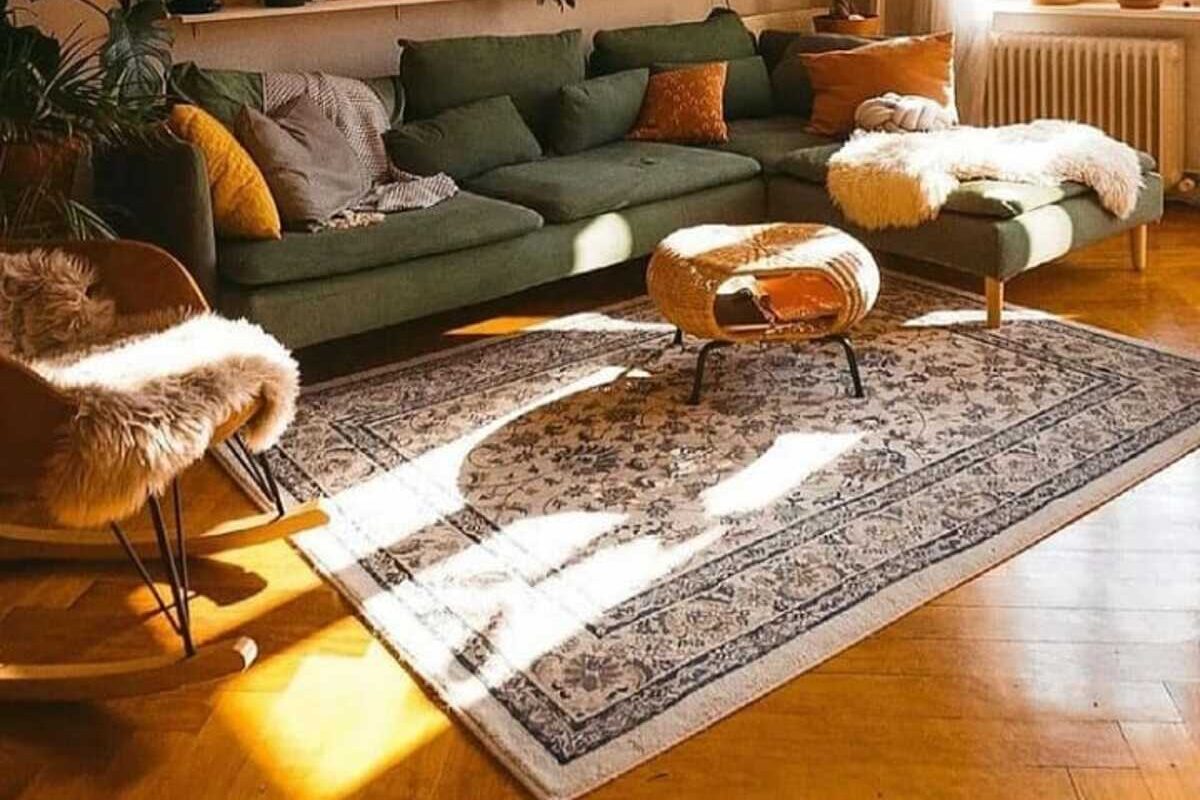
A sheepskin thrown over the corner of a chair looks casual, almost accidental. It isn’t. That one piece is often the softest thing in the room, and softness is what makes people actually sit down.
Fur and faux fur work in boho because they add loft. Most boho textures are flat, jute, cotton, linen, cane, all sitting close to the surface. Fur has height and shadow, so it catches light differently and creates a genuine dip in the visual rhythm. One sheepskin over a wooden stool, a mongolian fur pillow in a pile of woven ones, or a shaggy Flokati at the foot of a chair.
Restraint matters. Two fur pieces per room is plenty. More than that and it stops reading as cozy and starts looking like a costume shop.
There’s a reason it’s the spot everyone gravitates toward on a cold night.
12. Rattan Hanging Chair

A hanging rattan chair is one of those pieces that changes the mood of a room before anyone sits in it. Something about a seat that floats reads as unhurried.
Structurally it works because it opens up floor space. A regular armchair plants four legs and blocks a corner. A hanging chair leaves the floor visible underneath, so a small living room keeps its sense of air. The woven rattan also brings in that open, see-through texture that solid furniture can’t, letting light pass through instead of stopping it.
Hang it where there’s something worth looking at, near a window or facing the room rather than shoved into a dead corner. And check your ceiling joist properly. A drywall anchor is not going to hold a person.
🌟 Suggestion: Add a sheepskin to the seat and one small pillow at the lower back. Bare rattan digs in after ten minutes, and a chair nobody uses is just decoration taking up a corner.
13. Wall Basket Art
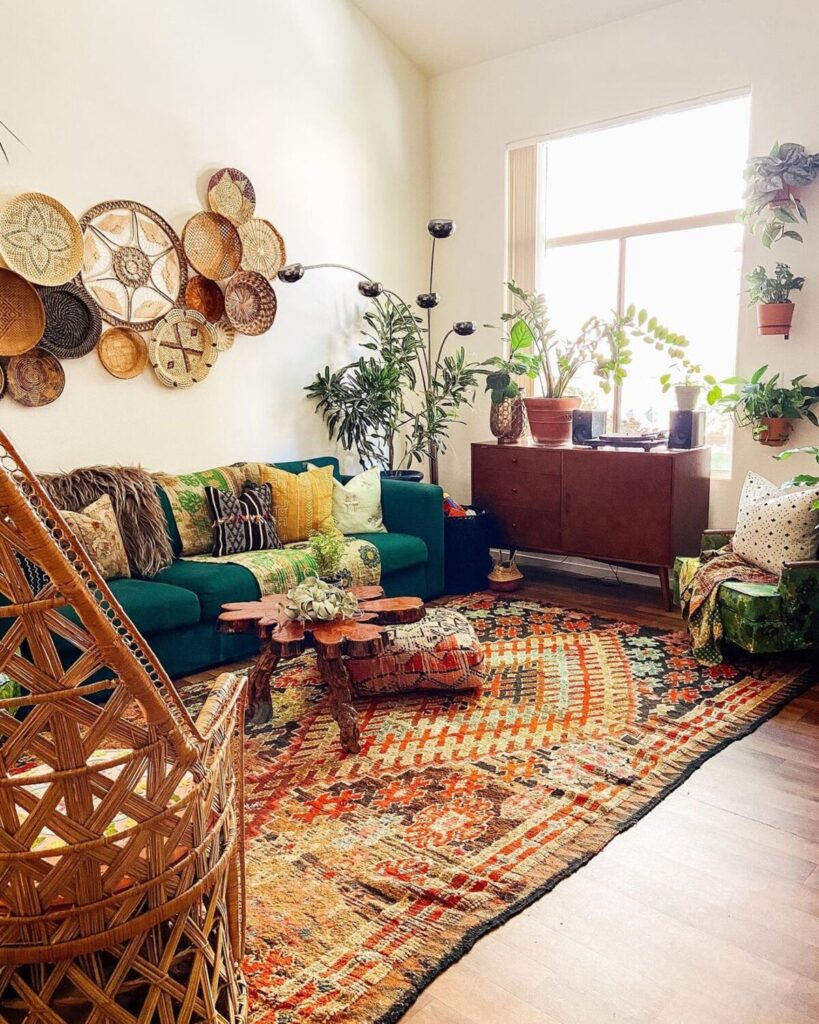
Flat woven baskets hung in a cluster solve a problem that framed art can’t. They fill a big blank wall with real dimension, and they cost a fraction of what proper artwork does.
The reason it lands so well is depth. A framed print sits flush against the wall. A basket stands out two or three inches, catches light from the side, and throws a soft shadow underneath, which makes the wall feel built rather than just decorated. Look for variation in diameter and tone, some pale palm leaf, some deeper coiled seagrass, maybe one with a faded stripe.
Arrange them in an uneven cluster instead of a grid. Grids look planned. Scattered clusters look gathered over time.
By late afternoon those shadows shift across the wall, and the whole arrangement quietly rearranges itself.
14. Mix Of Patterns
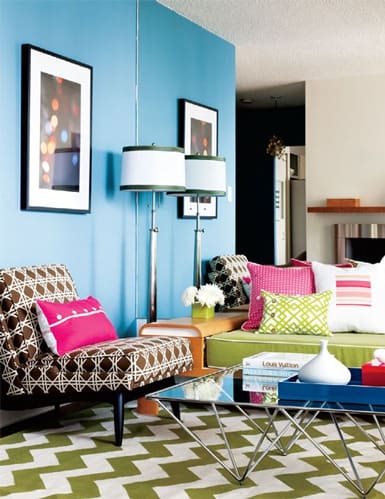
Most people freeze here, worried the room will turn into a mess. Fair concern, though the fix is simpler than it sounds.
Vary the scale. One large pattern, one medium, one small, and they’ll never compete for the same attention. A big geometric kilim on the floor, a medium ikat on a pillow, a fine stripe on the curtains. Then tie them together with one repeated color running through all three, even faintly. That shared thread is what your eye latches onto, and it’s the difference between layered and chaotic.
Leave breathing room too. A solid sofa or a plain wall between the busy pieces gives everything space to be seen.
Once the scales are right, you can keep adding patterns for years without the room ever tipping over.
15. Modern Bohemian Living Room
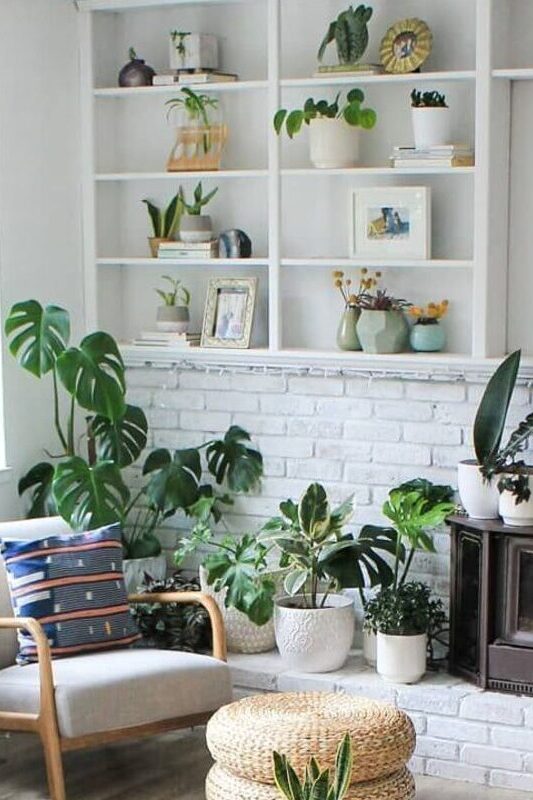
Modern boho is the version that appeals to people who love the texture but can’t live with the clutter. Cleaner lines, fewer objects, same warmth.
The whole approach rests on editing. Instead of six pillows you use three, but one is raw silk and one is thick handwoven wool. Instead of a gallery wall you hang a single oversized piece. Furniture stays low and simple, straight arms, tapered legs, nothing carved or fussy, and the boho comes through in materials rather than quantity. Cane, bouclé, unglazed ceramic, matte black metal.
Negative space does real work here. Those empty stretches of wall and floor make the few textured pieces feel deliberate instead of accidental.
💡 Pro tip: Before you add anything else, remove two things. Modern boho usually fails from too much, never too little, and that gap you’re tempted to fill is often the part making the room look expensive.
16. Bring In Colors To Create Character
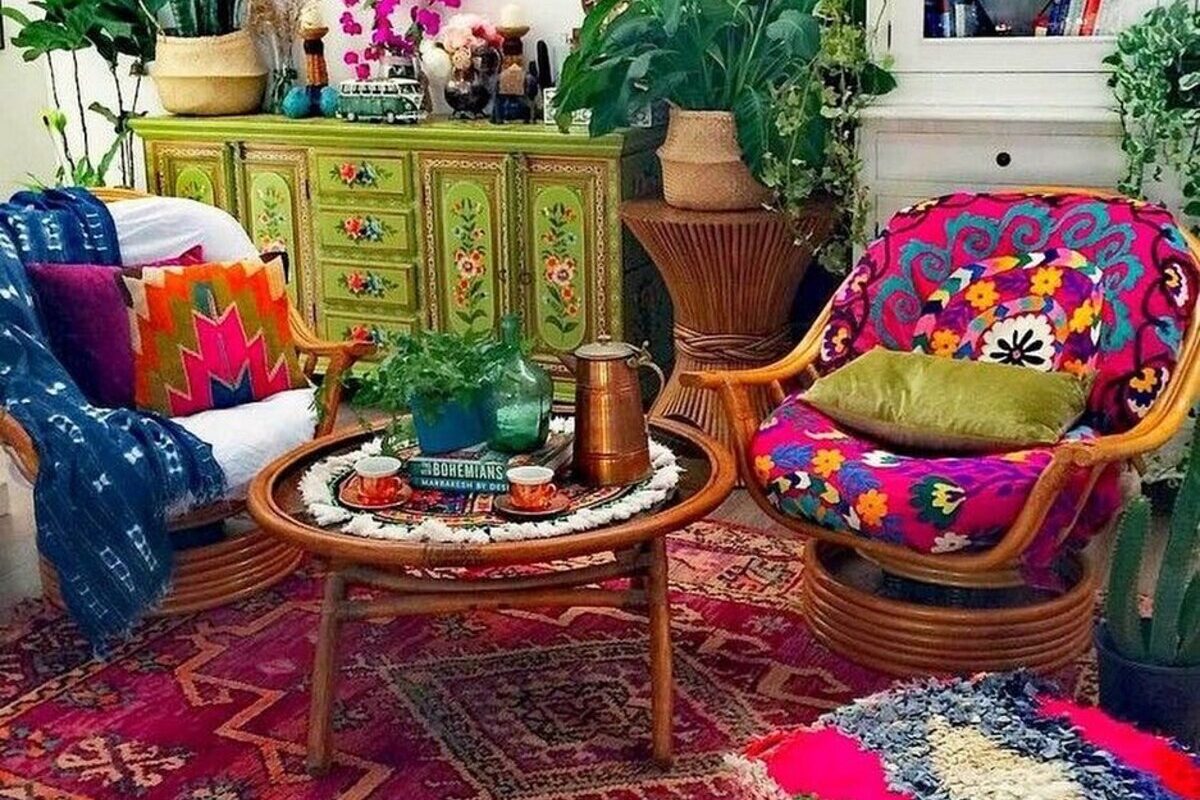
Neutrals are safe, and safe rooms are forgettable. At some point a boho space needs a color that actually says something about the person living in it.
Earth-adjacent shades hold up best because they already agree with jute, wood, and leather. Rust, mustard, olive, ochre, dusty rose, deep teal. Pick one as your lead and let it show up three times in different weights, maybe a rust velvet pillow, a rust stripe in the rug, a rust ceramic vase on the shelf. Repetition is what turns a random pop into an actual scheme.
Where it goes matters too. Color on something soft reads as warmth. The same shade painted across a whole wall can shrink the room fast.
There’s a certain satisfaction in walking in and seeing your color sitting right where you put it, doing its job.
17. Oriental Accents
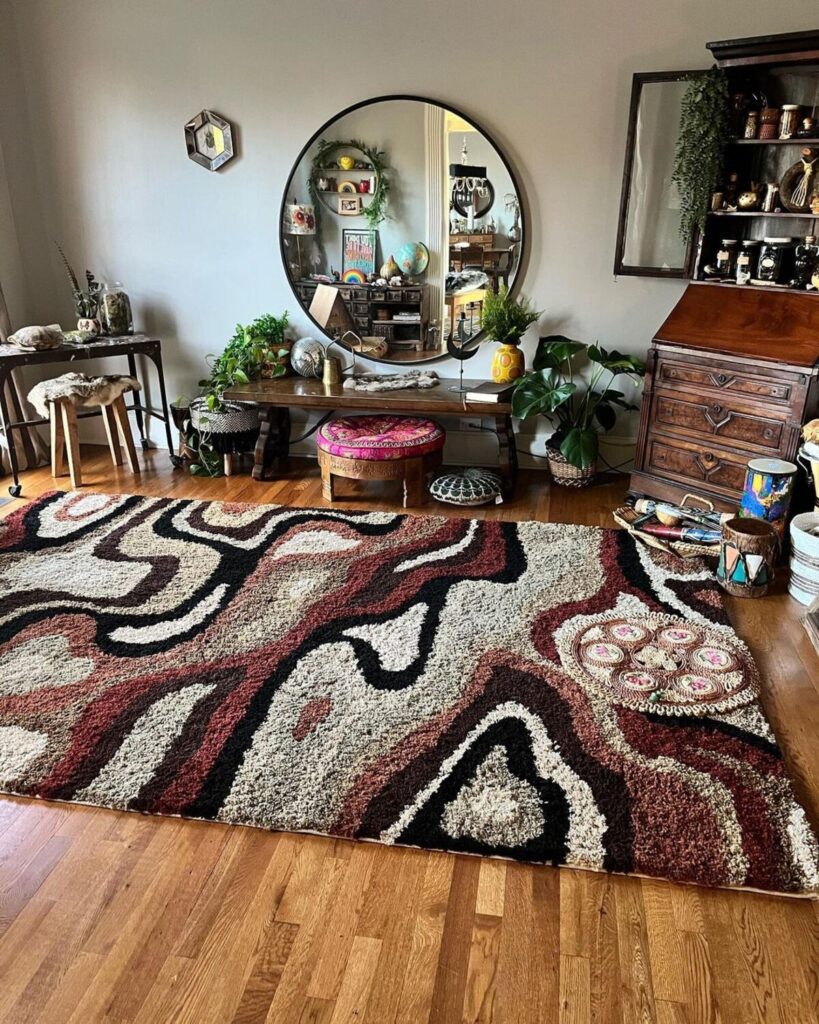
An old Persian or Turkish rug can carry a boho room almost single-handedly, especially one that’s gone thin and faded in the walking paths.
Those rugs work because age has already softened them. A brand new pattern shouts. A worn one has muted reds, faded indigo, and a slightly uneven weave, so the eye takes in the whole thing as texture rather than as a graphic. That’s why a busy antique rug sits comfortably under mismatched furniture while a crisp new print would fight everything around it.
Beyond rugs, look at hammered brass trays, low carved wooden stools, and glazed ceramics with imperfect finishes. Keep them spread around the room instead of grouped, so nothing turns into a display corner.
The real insight is that imperfection buys you freedom. Faded, chipped, and slightly off pieces let you break rules that pristine ones never would.
18. The More Plants, The Better

No boho room feels finished without something alive in it. Furniture and textiles can only take you so far, and then the space needs movement.
Plants do something no other decor can. They break up hard lines with irregular shapes, and their leaves move slightly in a draft, which keeps a styled room from looking frozen. Go for variety in habit rather than just variety in species. Something tall and architectural like a fiddle leaf fig or a rubber tree, something trailing off a shelf like pothos or string of pearls, and something low and spiky for contrast. Terracotta pots, woven baskets, and unglazed ceramic all beat plastic here.
Group them in odd numbers at different heights. Three plants clustered look intentional, three plants spread evenly look like they’re waiting to be watered.
Saturday morning turns into a slow loop with the watering can, checking leaves, turning pots toward the light.
19. Velvet Furniture

Velvet in a boho room sounds too fancy at first, until you see it sitting next to jute and rattan. Then it makes complete sense.
The pull is light. Velvet has a pile that shifts tone depending on where you stand, so an emerald or ochre sofa looks deep in one spot and almost glowing in another. Nothing else in a boho room does that. Everything around it, the woven baskets, the coarse rugs, the raw wood, absorbs light instead of reflecting it, which makes velvet feel like a small luxury rather than a mismatch.
You don’t need much. One velvet sofa, or even just two pillows on a linen couch, and the contrast is already doing its job.
Cotton velvet holds up better than crushed for daily use, and it wears into a soft patina rather than looking beaten up.
20. Organized Boho Living Room
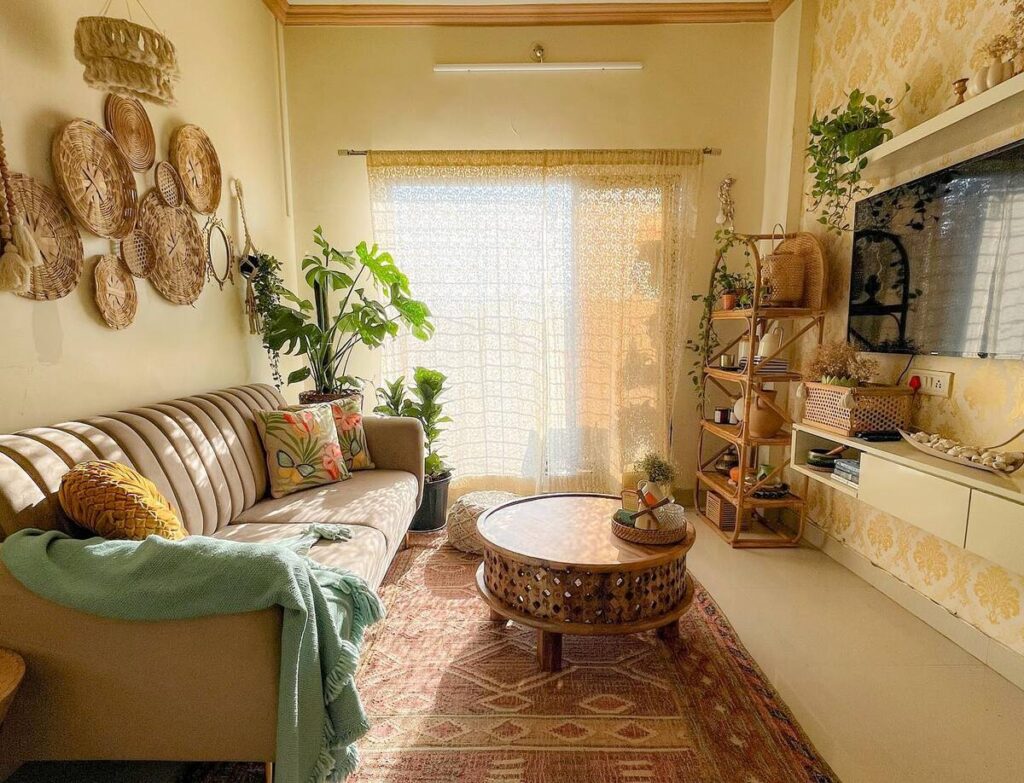
Boho gets blamed for being messy, but the rooms in every saved photo you’ve collected are usually well organized. The mess is just hidden well.
Storage is the reason it holds together. Lidded seagrass baskets swallow blankets, a low cane cabinet takes remotes and chargers, and a woven trunk works as both coffee table and toy box. Because all of that storage is made from the same natural fibers as the decor, it reads as part of the look instead of an interruption. That’s the trick plastic bins can never pull off.
Then leave surfaces mostly clear. One tray, one plant, one stack of books, and stop there. The layered feeling should come from textiles and texture, not from things piled on tables.
That’s the whole point of a boho room in the end. It should feel like somewhere you can drop your bag, put your feet up, and stay a while.
You Might Also Love These Ideas
- 20+ Ways to Organize Small Items. Tiny clutter tucked away neatly, leaving calm surfaces and warm open space to breathe.
- Closet Hack for Wire Shelves. A soft fabric fix that hides wire shelving and instantly warms up your closet.
- 18+ Clever DIY Organizing Ideas. Handmade fixes that bring quiet order to busy corners without losing that cozy, lived-in charm.
- 15+ Clever Storage Hacks. Simple tricks that clear cluttered shelves and leave rooms feeling light, airy, and restful
Frequently Asked Questions
What makes a living room boho instead of just eclectic?
Boho relies on natural materials and layered texture, not just mixed styles. Jute, rattan, wood, and linen appear repeatedly, with a warm earthy palette holding everything together. Eclectic rooms mix anything. Boho mixes within a shared material language, which is why it still feels calm.
How do I get a boho living room in a rental?
Lean on things that sit on the floor or lean against walls. A large jute rug, layered textiles, floor plants, and baskets propped rather than hung. Tension rods handle curtains without drilling. Most of the boho look lives below eye level anyway, so nothing needs permanent mounting.
Can boho work in a small living room?
Yes, and often better than expected. Keep furniture low and leggy so you can see the floor underneath, since visible floor makes rooms feel bigger. Use two or three textures instead of eight, hang one large piece rather than a gallery wall, and let plants climb upward instead of spreading out.
How many patterns are too many?
There’s no hard number, though scale matters more than count. Three patterns at different scales, large, medium, and small, will always sit better than three at the same size. Keep one color running through all of them, then leave a solid sofa or plain wall nearby so the eye gets a rest.
Why does my boho room look cluttered instead of cozy?
Usually it’s surfaces. Layered textiles read as cozy, but objects stacked on tables read as mess. Clear your coffee table down to one tray, one plant, and a small stack of books. Move the rest into lidded baskets. The texture stays, the visual noise disappears.
Is boho decorating expensive?
Not really, since the look depends on texture and age rather than new furniture. Thrifted rugs, secondhand wooden pieces, and baskets cost very little, and faded or slightly damaged items actually suit the style better. Plants and a few pillows fill the gaps. Buy slowly and the collected feeling builds on its own.
What plants work best if I forget to water them?
Snake plants, ZZ plants, and pothos survive real neglect and still look good doing it. Snake plants give you height, ZZ plants handle dim corners, and pothos trails off a shelf. Put them in terracotta or woven baskets and they read as intentional rather than low effort.
CONCLUSION
Boho living rooms don’t come together in a weekend, and honestly that’s the best part. The rooms that look effortless were built slowly, one thrifted rug and one leaning basket at a time, which is why they feel like someone actually lives there.
Pick two or three ideas from this list and start there. Maybe a jute rug and mixed wood tones, or a neutral base with one rust-colored accent repeated a few times. Get those working, then add. The layering does more when it happens gradually.
And keep the storage honest. A room can hold a dozen textures and still feel calm as long as the surfaces stay clear. That balance between layered and organized is the whole trick, and once you find it, the space stops looking styled and starts feeling like home.