12 Brown Sectional Sofa Ideas That Look Anything But Dated
Brown sectional sofas get a bad reputation, and honestly, it’s undeserved. That deep, earthy tone is one of the easiest colors to decorate around, mostly because brown already behaves like a neutral. It plays well with soft greens, warm creams, moody navy, and even a loud pop of mustard if the mood calls for it.
The tricky part is not the sofa. It’s everything around it. A big brown sectional takes up real space, so the walls, rug, and lighting have to give it room to breathe instead of fighting it. Get that balance right and the whole room starts feeling grounded, warm, and lived-in rather than dated.
The twelve looks ahead cover a wide range, from rustic cabin warmth to clean Scandi neutrals, plus a few color combinations most people never think to try with brown. Some ideas take a weekend. Others take one new rug and a couple of pillows.
Either way, that sofa everyone claims during movie night is about to look intentional instead of accidental.
1. Rustic Vibe with Shades of Green and Gray
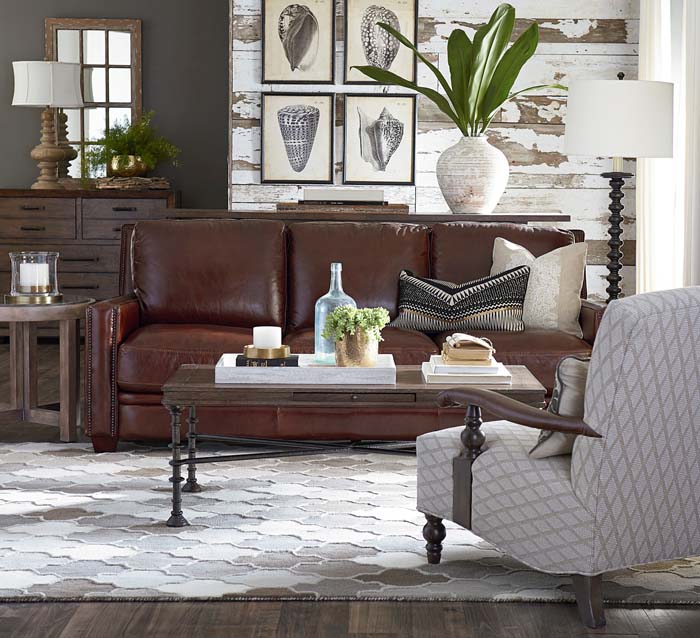
A brown sectional stops looking heavy the second sage green and soft gray show up beside it. Those two shades cool the room down just enough, so the sofa reads warm and grounded instead of dark and dated.
Think eucalyptus green pillows, a chunky gray knit throw, and a weathered oak coffee table with visible grain. The reason this combo works is simple: green and gray both sit on the cool side of the color wheel, so they push brown forward and let it act as the anchor. Add a few dried branches in a stone vase and the whole thing feels like a slow Saturday with the windows open and nowhere to be.
The room carries a calmer mood without trying hard.
💡 Pro Tip: Keep your greens muted (sage, olive, eucalyptus) rather than bright. Saturated greens compete with brown’s warmth, while dusty greens sit back and let the sofa lead.
2. Add a Stunning Area Rug
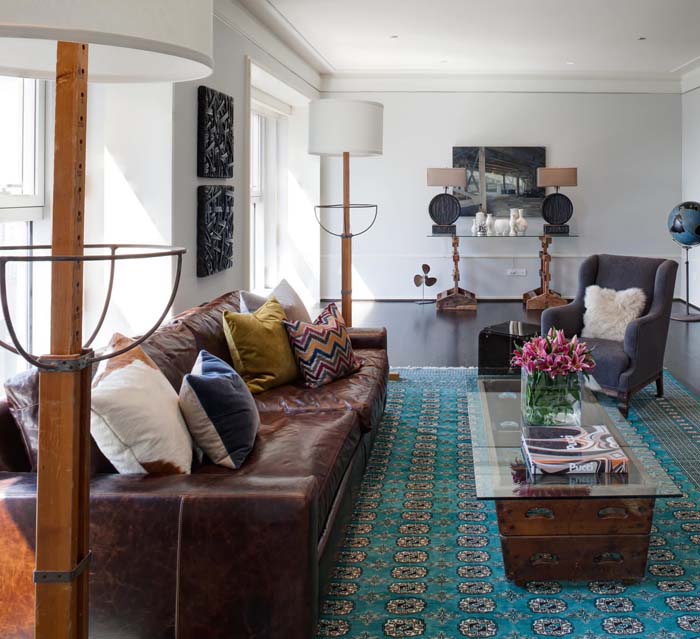
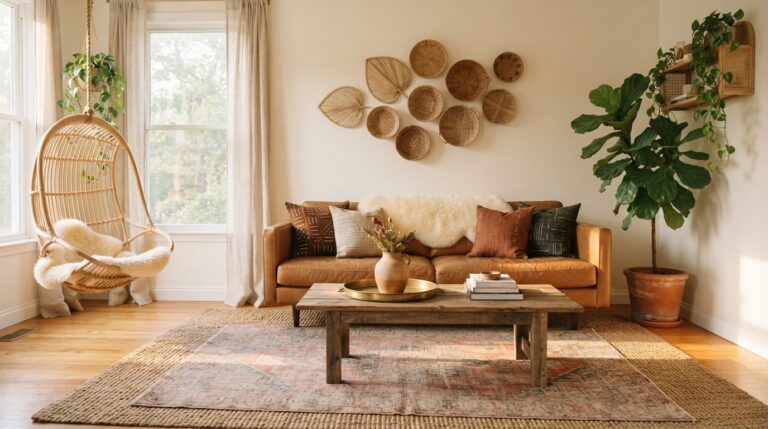
A brown sectional sitting straight on bare floor always looks a little unfinished, like the room forgot its last step. A large patterned rug fixes that instantly by drawing a visible boundary around the seating area.
Go bigger than feels reasonable. The rug should slide under the front legs of every seat, because when the edges tuck beneath the furniture, the sofa looks planted instead of parked. Cream and rust geometrics, faded Persian reds, or a woven jute layered with something softer all hold up against brown without disappearing into it. A low tray plus a few smart ways for organizing small items keeps the coffee table from swallowing remotes and coasters.
Suddenly the whole corner reads like one room, not scattered pieces.
3. White Walls and Gold Rims
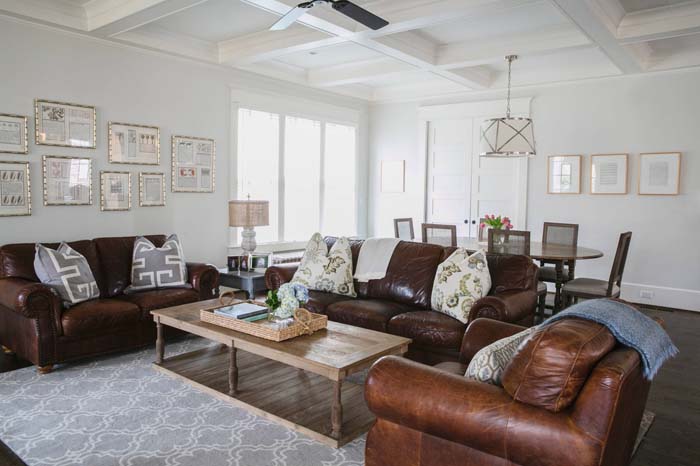
Crisp white walls give a brown sectional the breathing room it desperately wants. Dark upholstery against dark paint turns a living room into a cave, but white bounces light back and lets the sofa’s shape actually register.
Then bring in gold. Thin brass frames, a gold rimmed mirror, slim metallic legs on a side table, maybe a pair of candlesticks catching afternoon sun. Gold shares brown’s warm undertone, which is exactly why the pairing feels expensive rather than random. The metal picks up the amber notes already living in the leather or fabric and repeats them at eye level.
Small detail, big shift. The room stops looking like brown furniture in a white box and starts looking styled on purpose.
4. Pair Beige and White with Nature and Light
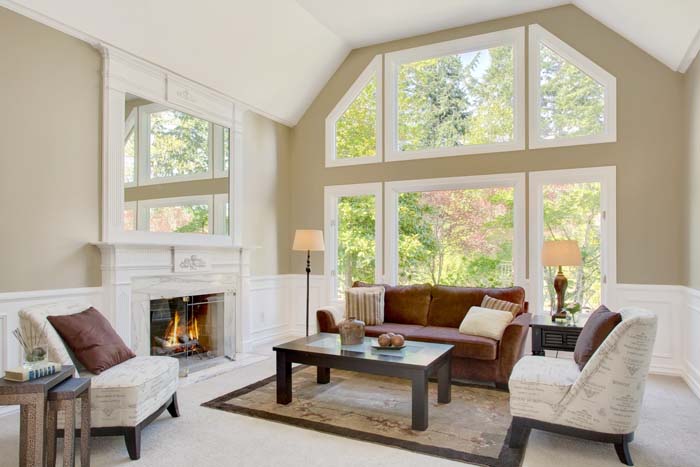
Beige gets called boring right up until you put it next to brown. Then it turns into the softest possible landing, blurring the line between sofa and room so nothing feels blocky.
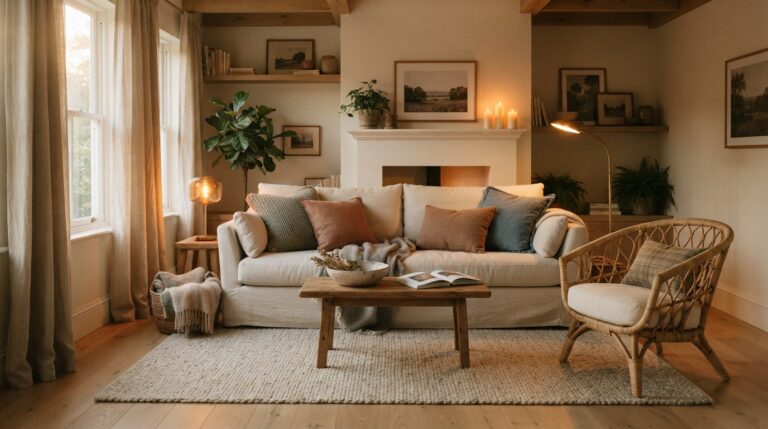
Layer it in stages. Oatmeal linen pillows, an ivory throw, sheer curtains that let light pour through instead of blocking it. The logic behind this is tonal, meaning every shade sits in the same family, so your eye glides across the room rather than stopping at hard edges. Then add real plants, because green leaves against beige and brown mimic exactly what happens outdoors.
Pull the curtains back on a bright morning and the sofa practically glows. Guests always ask what changed, and honestly, it was just light and a fig tree.
5. Get the Lodge Look
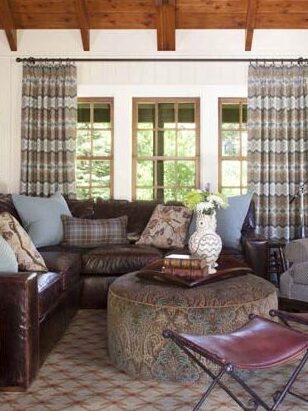
Brown sectionals were basically built for cabin energy, so leaning into it is the path of least resistance. Think plaid blankets, antler or branch wall pieces, a stone fireplace surround, and lighting warm enough to make everyone stay put.
Texture carries this one. Wool, sheepskin, raw wood, blackened metal, all piled together on purpose because lodge style relies on things that look touched and used rather than showroom clean. Woven baskets tucked beside the sectional hold extra throws, and if your storage nook still has exposed racks, a simple closet hack for wire shelves hides them fast.
The payoff is that first cold evening when the lamps go on, the blankets come out, and nobody wants to leave the couch.
💡 Pro Tip: Swap cool white bulbs for warm ones around 2700K. Lodge rooms live or die by bulb temperature, and cool light instantly makes brown look flat and gray.
6. Opposites Connect
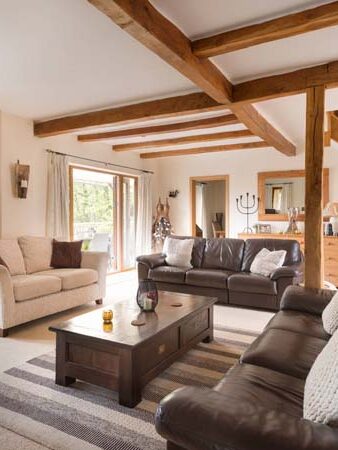
Brown does something unexpected when you stop treating it gently. Put it beside a cool, sharp color and the contrast wakes both sides up. Icy blue, charcoal, even black accents create tension that a matchy room never gets close to.
Here’s the reasoning. Brown is warm and soft edged, so cool tones give your eye a resting point and stop everything from blending into one muddy layer. A black metal floor lamp, a slate blue armchair, a few crisp white ceramics on the shelf. Each piece pushes against the sofa instead of agreeing with it.
The room ends up looking collected over time rather than bought in one trip, which is the whole point.
🎨 Suggestion: Try one cool accent at three different heights, floor lamp, mid level pillow, upper shelf object. Repeating the contrast color vertically makes it look deliberate instead of accidental.
7. Rich Navy, Cream and Taupe

Navy is the color most people skip with brown, and it’s the one that transforms the room fastest. Deep blue reads almost like a neutral once it’s paired with cream, and together they make brown look intentional rather than inherited.
The three work as a hierarchy. Brown holds the weight, navy adds depth in smaller doses, cream keeps the whole thing from feeling closed in. So a navy accent wall behind the sectional, cream pillows to break it up, taupe curtains softening the corners. A media console styled with a few smart IKEA storage hacks hides the cable chaos most living rooms pretend not to have.
8. Choose One Bright Pop of Color

One loud color is all a brown sectional needs to stop looking serious. Mustard yellow, burnt orange, terracotta, or a punchy teal, pick a single shade and let it show up in three or four spots around the room.
Restraint is what makes this land. Brown is already a full, saturated color, so two or three bright accents start competing and the room gets noisy. Stick with one and it reads like a deliberate choice. Two mustard pillows, a matching ceramic vase, maybe a piece of art carrying the same tone in one corner.
Walk in on a gray afternoon and that yellow does something to your mood before you’ve even sat down. Cheap trick, honestly, but it works every time.
9. Break Up the Pattern in Your Brown Sectional Sofa

A large sectional in one solid color turns into a big brown block, especially in smaller rooms. Pattern breaks that surface up so your eye has somewhere to travel instead of stalling on all that upholstery.
Mix your scales. One oversized print, one small repeating pattern, one solid textured piece, all sharing at least one common color so the group holds together. Stripes with florals, plaid with a subtle geometric, whatever feels right when you stack them. Storage baskets and a few clever hidden storage spots tuck the overflow out of sight once the pillow collection grows.
The sectional suddenly looks smaller than it actually is, which is the strange gift pattern gives you.
10. A Beautiful Study in Neutrals

Sometimes the smartest move with a brown sectional is adding almost no color at all. Cream, greige, warm white, soft camel, mushroom, all sitting quietly in the same room while the sofa does the heavy lifting.
Texture becomes your color in a setup like this. Because nothing competes visually, your eye starts reading surfaces instead: bouclé, linen, smooth plaster walls, a nubby wool rug, ceramic with a matte finish. That’s why an all neutral room can feel rich rather than empty. Remove the contrast and the materials get promoted.
The result is a space that lowers your shoulders the moment you walk in. Nothing shouting, nothing trendy, just a room that stays calm no matter what kind of day happened before you got home.
💡 Pro Tip: Keep at least four distinct textures in a neutral room. Fewer than that and the space tips from serene into flat, which is the only real risk with this palette.
11. Green Accents and a Patterned Rug
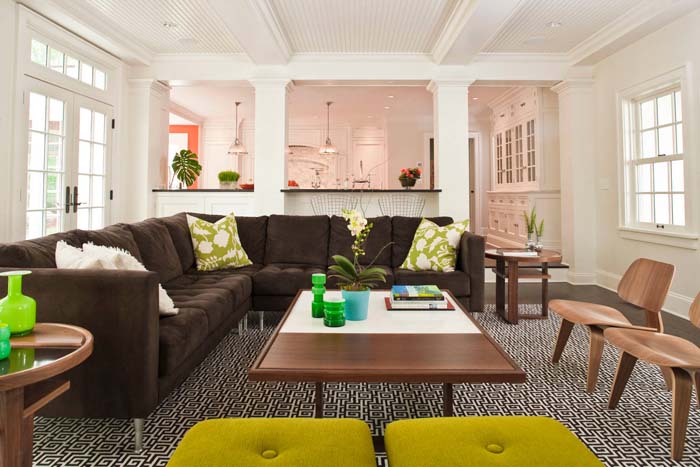
Green and brown never need convincing. They already exist together in every forest, which is exactly why the pairing feels settled the moment you try it. What changes the outcome is the rug underneath.
Pick a patterned rug that carries green somewhere in the design, even faintly, then echo it upward. Olive velvet pillows, a trailing pothos on the shelf, a ribbed vase in bottle green. Repeating one color at floor level and again at eye level ties the room vertically, so the sectional stops floating and starts belonging to the space around it.
Rooms like this tend to become the spot everyone drifts toward. Something about green makes people slow down and stay a while.
12. Use Deep, Rich Brown Hues Throughout the Room
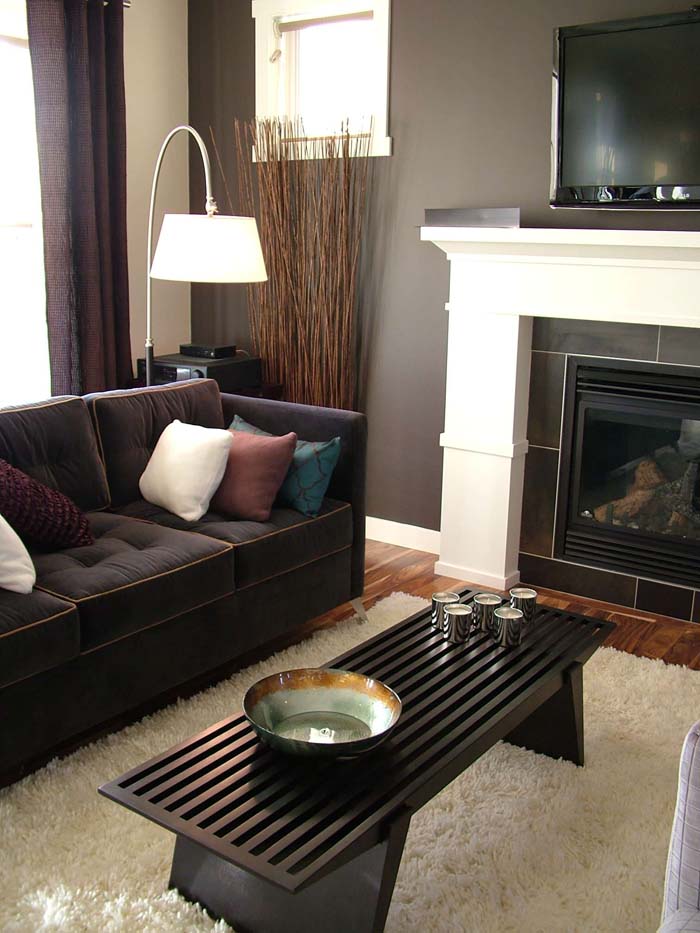
Instead of hiding the brown, commit to it completely. Chocolate walls, a cognac leather chair, walnut shelving, coffee toned curtains, all in the same family but never the exact same shade.
Vary the depth and the finish. Matte paint beside glossy wood beside soft suede gives the eye something to distinguish, which is what keeps a monochrome room from reading as one flat surface. Then let a little cream break through in a lampshade or a stack of books, just enough to mark the edges. Layered browns feel enveloping in the way a library or an old study does, closed in on purpose.
Evenings hit differently in a room like this. Lamps on, everything glowing amber, and that sectional finally looks like the best decision in the house.
Frequently Asked Questions
What wall color goes best with a brown sectional sofa?
Warm white and soft cream win most often, simply because they reflect light and keep the sofa from dominating the room. Sage green and greige work beautifully too if you want more mood. Navy is the bold pick and it looks incredible, though it needs decent natural light to avoid closing the space in. If your room only gets afternoon sun, stay on the lighter end and let the sofa provide the depth.
Is a brown sectional outdated?
Not even close. Brown fell out of style for about a decade, which is why it carries that reputation, but it’s back in a big way through cognac leather and chocolate upholstery. What actually dates a room is the styling around the sofa: heavy dark curtains, matching wood sets, and cool white overhead lighting. Change those three things and a brown sectional reads current immediately.
What color rug looks good with a brown couch?
Cream, ivory, and light gray give the strongest contrast and make the sofa look intentional rather than heavy. Faded reds and rust patterns pull out brown’s warm undertones if you want something richer. Avoid rugs that sit too close to the sofa’s exact shade, because when the two blend, the seating area loses its outline and the whole corner starts looking like one large mass.
Should throw pillows match a brown sectional?
Please don’t match them. Same tone pillows disappear into the upholstery and the sofa ends up looking bigger and flatter than it is. Contrast is what gives the surface definition. Mix two or three pillow colors, vary the sizes, and include at least one patterned cover. Different textures matter as much as color here, so a velvet beside a chunky knit does real work even in a quiet palette.
How do I make a brown sectional look more modern?
Lighten everything around it. Swap in a pale rug, hang simple art with thin frames, add slim metal legs on side tables, and switch to warm bulbs in a few lamps rather than relying on one ceiling fixture. Clean lines nearby do most of the heavy lifting. One or two contemporary accents, like a sculptural vase or a black arc lamp, shift the read of the entire room.
What accent colors work with brown furniture?
Sage green, mustard, terracotta, navy, and cream are the reliable five. Brown sits in the warm half of the color wheel, so cool accents create contrast while warm ones deepen the cozy effect. Pick one direction and stick with it. The most common mistake is scattering four or five accent colors around the room, which makes the space feel busy instead of layered.
CONCLUSION
A brown sectional was never the problem. The room around it was.
That’s the thread running through all twelve of these looks. Whether you go full lodge, keep everything neutral, or throw one mustard pillow into the mix, the sofa itself barely changes. What changes is the light, the rug, the wall color, and how much breathing room you give that big warm shape sitting in the middle of everything.
Start with whatever feels easiest. Swap your bulbs for something warmer. Size up the rug. Add two plants and pull the curtains all the way back. None of that takes a weekend, and any one of them shifts how the whole room reads.
Then live with it for a week before you decide what’s next. Rooms tend to tell you what they’re missing once you stop staring at them.
The brown sectional everyone said was outdated is about to become the reason people compliment your living room.